Impact Factor ISSN: 1837-9664




J Cancer 2026; 17(12):2071-2081. doi:10.7150/jca.142595 This issue Cite
Research Paper
Real-World Experience with Neoadjuvant Treatment for Stage I-III Non-Small Cell Lung Cancer: A Single-Center Cohort Study and TriNetX database
Yi-Wen Chen1,2, Cheng-Yen Chuang2, Chih-Hung Lin2,3, Yen-Hsiang Huang4,5,6, Kuo-Hsuan Hsu4,5, Po-Hsin Lee4,5,6,7,8, Tsung-Ying Yang4,5,7,8, Jeng-Sen Tseng3,4,5,6,9  , Shun-Fa Yang1,10
1. Institute of Medicine, Chung Shan Medical University, Taichung, Taiwan.
2. Division of Thoracic Surgery, Department of Surgery, Taichung Veterans General Hospital, Taichung, Taiwan.
3. Department of Post-Baccalaureate Medicine, College of Medicine, National Chung Hsing University, Taichung, Taiwan.
4. Department of Chest Medicine, Taichung Veterans General Hospital, Taichung, Taiwan.
5. Lung Cancer Comprehensive Care and Research Center, Taichung Veterans General Hospital, Taichung, Taiwan.
6. Faculty of Medicine, School of Medicine, National Yang Ming Chiao Tung University, Taipei, Taiwan.
7. Doctoral Program in Translational Medicine, National Chung Hsing University, Taichung, Taiwan.
8. Rong Hsing Translational Medicine Research Center, National Chung Hsing University, Taichung, Taiwan.
9. Institute of Biomedical Sciences, National Chung Hsing University, Taichung, Taiwan.
10. Department of Medical Research, Chung Shan Medical University Hospital, Taichung, Taiwan.
Received 2026-8-15; Accepted 2026-10-28; Published 2026-11-13
Abstract
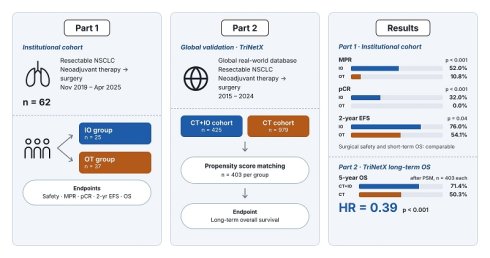
Breakthroughs in immune checkpoint inhibitors (ICIs) are rapidly shifting the treatment paradigm for resectable non-small cell lung cancer (NSCLC) toward neoadjuvant and perioperative strategies. To assess the real-world efficacy and broad applicability of neoadjuvant immunotherapy, we analyzed 62 patients who received neoadjuvant systemic therapy followed by surgery at Taichung Veterans General Hospital between November 2019 and April 2025, dividing the cohort into an immunotherapy (IO) group and another therapy (OT) group. A parallel global cohort from the TriNetX database was used to validate long-term survival outcomes. Surgical safety was comparable between groups. The IO group achieved significantly higher major pathological response (MPR: 52.0% vs. 10.8%, p < 0.001) and pathological complete response (pCR: 32.0% vs. 0.0%, p < 0.001), as well as improved two-year event-free survival (76.0% vs. 54.1%, p = 0.04). While short-term overall survival was similar, TriNetX analysis with propensity score matching confirmed significantly superior long-term overall survival for the IO cohort (Hazard Ratio = 0.39, p < 0.001). These findings demonstrate that real-world neoadjuvant chemo-immunotherapy is both safe and effective, with validated long-term survival benefits across diverse populations.
Keywords: immune checkpoint inhibitors, pathological complete response, TriNetX database
1. Introduction
Lung cancer remains the leading cause of cancer-related mortality worldwide, responsible for approximately 1.8 million deaths annually [1]. It is histologically classified into non-small cell lung cancer (NSCLC), which accounts for 85% of cases, and small cell lung cancer. Despite advances in low-dose chest CT screening, a significant proportion of patients are diagnosed at locally advanced or metastatic stages, resulting in a 5-year survival rate that remains lower than that of many other malignancies [2].
In the past, the standard of care for early-stage resectable NSCLC has been surgery followed by adjuvant chemotherapy for patients with high-risk features. However, the recurrence rates remain high, with distant metastasis being the primary cause of treatment failure. Over the past two decades, the treatment paradigm has shifted towards precision medicine. With the widespread adoption of next-generation sequencing and comprehensive genetic profiling and biomarker assessment, small-molecule targeted therapies and immunotherapy (IO) have revolutionized the management of advanced NSCLC and considerably improved overall survival (OS) [3].
Building on the success achieved in advanced NSCLC, current research is increasingly focused on incorporating these systemic therapies into the neoadjuvant setting for patients with resectable disease [4]. By aiming to downstage tumors, increase the likelihood of complete resection (R0), and eradicate micro-metastases earlier, neoadjuvant and perioperative chemo-IO are rapidly transforming the standard of care for resectable NSCLC, driven by pivotal phase III trials. CheckMate 816 established the foundation as the first positive neoadjuvant-only trial, demonstrating that three cycles of nivolumab plus chemotherapy remarkably improved pathological complete response (pCR), event-free survival (EFS), and OS compared with chemotherapy alone [5, 6]. Following this success, the field moved towards a perioperative design. Sandwiching surgery between neoadjuvant chemo-IO and adjuvant IO potentially maximizes tumor eradication and controls micro-metastases. This strategy was validated by KEYNOTE-671 with pembrolizumab [7], CheckMate 77T with nivolumab [8], and AEGEAN with durvalumab [9]. All three trials confirmed that the perioperative approach considerably enhances pCR and EFS. Complementing this landscape is the ongoing IMpower030 trial, which evaluates a similar perioperative regimen by using atezolizumab [10]. While phase III trials provide robust evidence of efficacy, their highly selected patients with younger age and better performance status often limit generalizability. Therefore, real-world evidence could potentially complement trial data by providing insights into treatment patterns, adherence, and toxicity in broader populations. The present study seeks to elucidate the effect of neoadjuvant IO-based combinations within clinical practice and the TriNetX database.
2. Methods
2.1. Study design and patient selection
Patients with stages I-III NSCLC who underwent neoadjuvant treatment followed by surgery at Taichung Veterans General Hospital from November 2019 to April 2025 were retrospectively reviewed. The study was approved by the Institutional Review Board (IRB) of TCVGH, Taiwan (IRB No. CE26049A), in accordance with the Declaration of Helsinki principles.
All of the patients were required to meet the following criteria: (1) histologically or cytologically confirmed NSCLC; (2) clinical stages I-III disease at initial diagnosis, classified in accordance with the eighth edition of the American Joint Committee on Cancer staging system; (3) receiving neoadjuvant therapy, including chemotherapy, IO, or targeted therapy prior to surgery; (4) undergoing curative-intent surgical resection, including lobectomy, sleeve lobectomy, bilobectomy, or segmentectomy with systematic mediastinal lymph node dissection; and (5) resectability confirmed by multidisciplinary team discussion. Patients were excluded if they received chemoradiotherapy, had unresectable disease, did not complete neoadjuvant treatment, or had incomplete medical records such as baseline clinical characteristics, operative details, and pathological reports. Final follow-up was completed on February 25, 2026.
Clinicopathological characteristics, including age, gender, clinical staging, histology, American Society of Anesthesiologists (ASA) physical status classification score, surgery type, and programmed death ligand 1 (PD-L1) level, were documented. The patients were stratified into two groups on the basis of the neoadjuvant regimen administered. The IO group comprised patients who received immune checkpoint inhibitors in combination with platinum-based chemotherapy. The OT (other therapies) group served as the comparator arm, encompassing patients treated with either chemotherapy alone or molecular targeted therapy. The outcome parameters included major pathological response (MPR), pCR, duration of surgery, intraoperative blood loss, the rate of conversion to open surgery and the standardized Clavien-Dindo classification system for postoperative surgical complications.
2.2. TriNetX database
The TriNetX network database in the period 2015-2024 was analyzed. The data used in this study were collected on October 3rd, 2026, from the TriNetX Global Collaborative Network, which provides access to electronic medical records (diagnoses, procedures, medications, and laboratory values) from millions of patients globally. From this database, a specific cohort of 1,404 patients across 187 healthcare organizations was extracted for our study. Patients with the diagnosis of lung cancer, those with a history of neoadjuvant chemotherapy or chemotherapy with IO, and those receiving lobectomy afterwards were included for analysis. Patients treated with targeted therapy were excluded.
The data collected from the TriNetX database included age at diagnosis, sex, body mass index (BMI), race, pulmonary function represented by the forced expiratory volume in one second (FEV1), and serum levels of carcinoembryonic antigen (CEA), comorbidities, such as chronic obstructive pulmonary disease (COPD), hypertension, coronary artery disease (CAD), cerebrovascular accident (CVA), liver disease, as well as diabetes mellitus, neoadjuvant IO medications, and survival time.
2.3. Primary and secondary endpoints
The primary endpoints of this study were MPR and pCR, which were assessed using the IASLC recommendations [11]. The secondary endpoints encompassed surgical outcomes and early survival metrics. Surgical endpoints, including duration of surgery, estimated intraoperative blood loss, and rate of conversion to open surgery, were utilized to evaluate the feasibility and safety of the procedures following neoadjuvant therapy. Given the relatively short follow-up duration of the cohort, the survival analyses focused on the 2-year EFS and 2-year OS rates. EFS was defined as the time from the initiation of neoadjuvant treatment to the occurrence of any of the following events: disease progression precluding surgery, disease recurrence after surgery, or death of any cause. OS was calculated from the start of neoadjuvant treatment to death of any cause.
2.4. Statistical methods
Descriptive statistics were utilized to summarize the patient demographic and clinical characteristics. Continuous variables, such as age, BMI, FEV1, and CEA levels, were presented as means with standard deviations (SDs) and compared using Student's t-test or the Mann-Whitney U test. Categorical variables, including gender, histology, clinical stage, ASA physical status classification score, and PD-L1 level, were expressed as frequencies and percentages and compared using chi-square test or Fisher's exact test. The survival curves for OS and EFS were estimated using the Kaplan-Meier method. Median follow-up was estimated using the reverse Kaplan-Meier method, in which death was treated as a censoring event and patients alive at last contact were treated as events. Follow-up was calculated from the date of initiation of neoadjuvant therapy to the date of last follow-up or death, based on the overall survival data. Because observation time in the EFS analysis ends at the first event, follow-up derived from EFS data would be truncated at recurrence and a single follow-up estimate per group was therefore reported. All statistical analyses were performed using SPSS software (version 25.0 for Windows; SPSS Inc., Chicago, IL, USA). Statistical significance was defined as p < 0.05.
3. Results
3.1. Patient characteristics
A total of 62 patients were included in this study, with 25 patients in the IO group and 37 patients in the OT group. Three patients were treated with atezolizumab, 10 patients with nivolumab, six patients with pembrolizumab, and six patients with durvalumab in the IO group. In the OT group, five patients had EGFR (epidermal growth factor receptor) exon 19 deletions, one patient had exon 20 insertions, and two patients had exon 21 L858R mutation, and they all received EGFR-tyrosine kinase inhibitor (TKI) as neoadjuvant agents. The IO group had no patients with EGFR mutations. The demographic and clinical characteristics are summarized in Table 1.
The Demographic Characteristics of immunotherapy group and other therapy group.
| Total (n = 62) | IO group (n =25) | OT group (n = 37) | p | |
|---|---|---|---|---|
| Age (years old) | 0.490 | |||
| Mean ± SD | 59.3 ± 9.71 | 57.9 ± 12.35 | 61.22 ± 7.33 | |
| Sex | 0.315 | |||
| Male | 40 (64.5%) | 18 (72.0%) | 22 (59.5%) | |
| Female | 22 (35.5%) | 7 (28.0%) | 15 (40.5%) | |
| Clinical stage | 0.290 | |||
| IB | 5 (8.1%) | 1 (4.0%) | 4 (10.8%) | |
| IIA | 1 (1.6%) | 1 (4.0%) | 0 (0.0%) | |
| IIB | 6 (9.7%) | 4 (16.0%) | 2 (5.4%) | |
| IIIA | 24 (38.7%) | 7 (28.0%) | 17 (45.9%) | |
| IIIB | 21 (33.9%) | 9 (36.0%) | 12 (32.4%) | |
| IIIC | 5 (8.0%) | 3 (12.0%) | 2 (5.4%) | |
| ASA | 0.431 | |||
| 1 | 1 (1.6%) | 1 (4.0%) | 0 (0.0%) | |
| 2 | 45 (72.6%) | 17 (68.0%) | 28 (75.7%) | |
| 3 | 16 (25.8%) | 7 (28.0%) | 9 (24.3%) | |
| Histology | 0.092 | |||
| Adenocarcinoma | 43 (69.4%) | 15 (60.0%) | 28 (75.7%) | |
| Squamous cell | 15 (24.2%) | 6 (24.0%) | 9 (24.3%) | |
| Large cell | 1 (1.6%) | 1 (4.0%) | 0 (0.0%) | |
| Lymphoepithelioma-like carcinoma | 3 (4.8%) | 3 (12.0%) | 0 (0.0%) | |
| Surgery | 0.258 | |||
| Lobectomy | 55 (88.7%) | 22 (88.0%) | 33 (89.2%) | |
| Bilobectomy | 2 (3.2%) | 2 (8.0%) | 0 (0.0%) | |
| Sleeve lobectomy | 4 (6.5%) | 1 (4.0%) | 3 (8.1%) | |
| Segmentectomy | 1 (1.6%) | 0 (0.0%) | 1 (2.7%) | |
| PD-L1 | 0.001 | |||
| Negative (< 1%) | 26 (41.9%) | 4 (16.0%) | 22 (59.5%) | |
| Low (1-49%) | 22 (35.5%) | 11 (44.0%) | 11 (29.7%) | |
| High (> 50%) | 14 (22.6%) | 10 (40.0%) | 4 (10.8%) |
Abbreviation: ASA, American Society of Anesthesiologists physical status classification system; IO, Immunotherapy; OT, other therapy; PD-L1, programmed death-ligand 1; SD, Standard Deviation
No statistically significant differences were observed between the IO and OT groups in terms of age (p = 0.490), sex (p = 0.315), clinical stage (p = 0.290), ASA physical status classification score (p = 0.431), tumor histology (p = 0.092), and type of surgery (p = 0.258). Overall, most patients presented with stage IIIA (38.7%) or IIIB (33.9%) disease, and the majority had an ASA physical status classification score of 2 (72.6%). Adenocarcinoma was the most common histological type (69.4%), followed by squamous cell carcinoma (24.2%). The most frequently performed surgical procedure was lobectomy, accounting for 88.7% of all cases.
The PD-L1 expression levels showed a highly significant difference between the two groups (p = 0.001). The OT group predominantly exhibited negative PD-L1 expression, representing 59.5% of the group. By contrast, a larger proportion of patients in the IO group demonstrated low (1%-49%) and high (> 50%) PD-L1 expression levels, accounting for 44.0% and 40.0% of the group, respectively.
3.2. Radiological, surgical, and pathological outcomes
Table 2 summarizes the radiological and surgical results and pathologic responses for both groups. No significant differences were found between the two groups in terms of surgical time (4.4 ± 1.3 vs. 4.6 ± 2.0 hours, p = 0.939), length of hospital stay (6.6 ± 5.7 vs. 7.1 ± 8.0 days, p = 0.696), and blood loss (0 [ IQR, interquartile ranges, 0-100] vs. 100 [ IQR, 0-200] mL, p = 0.169). The conversion rates were similar between the two groups (8.0% vs. 5.4%, p = 0.686). Postoperative complications were assessed using the Clavien-Dindo classification. The incidence of major complications (Grade ≥ III) was low and comparable between the IO and OT groups (4.0% vs. 2.7%, p = 0.779). The vast majority of patients in both cohorts experienced only minor complications (Grade I-II).
Radiological, surgical and pathological outcomes in the immunotherapy group and other therapy group.
| IO group (n = 25) | OT group (n = 37) | p | |
|---|---|---|---|
| Surgical time (hours), Mean ± SD | 4.4 ± 1.3 | 4.6 ± 2.0 | 0.939 |
| Hospital stay (days), Mean ± SD | 6.6 ± 5.7 | 7.1 ± 8.0 | 0.696 |
| Blood loss (ml), Median (IQR)* | 0 (0-100) | 100 (0-200) | 0.169 |
| Conversion rate (%) | 2 (8.0%) | 2 (5.4%) | 0.686 |
| Clavien-Dindo classification (%) | 0.779 | ||
| Grade I-II | 24(96.0%) | 36(97.3%) | |
| Grade ≥ III | 1(4.0%) | 1(2.7%) | |
| MPR (%) | 13 (52.0%) | 4 (10.8%) | < 0.001 |
| pCR (%) | 8 (32.0%) | 0 (0.0%) | < 0.001 |
| Response by RECIST criteria | 0.522 | ||
| Partial response | 18 (72.0%) | 29 (78.4%) | |
| Stable disease | 7 (28.0%) | 7 (18.9%) | |
| Progressive disease | 0 (0.0%) | 1 (2.7%) |
Abbreviation: IO, Immunotherapy; IQR, interquartile range; MPR, major pathologic response; OT, other therapy; pCR, pathologic complete response; RECIST, response evaluation criteria in solid tumors
* Data are presented as median (interquartile range) and compared using the Mann-Whitney U test.
Notably, the IO group demonstrated significantly better pathologic responses. The MPR rate was significantly higher in the IO group than in the OT group (52.0% vs. 10.8%, p < 0.001). Furthermore, pCR was achieved in 32.0% of the patients in the IO group, whereas no patients (0.0%) in the OT group achieved pCR (p < 0.001). Following surgery, the proportion of patients receiving adjuvant therapy did not differ significantly between the IO and OT groups (64.0% vs. 70.3%, p = 0.607). Despite these profound differences in pathological clearance, the radiological response assessed via the RECIST criteria did not significantly differ between the two groups (p = 0.522).
3.3. Analysis of EFS and OS
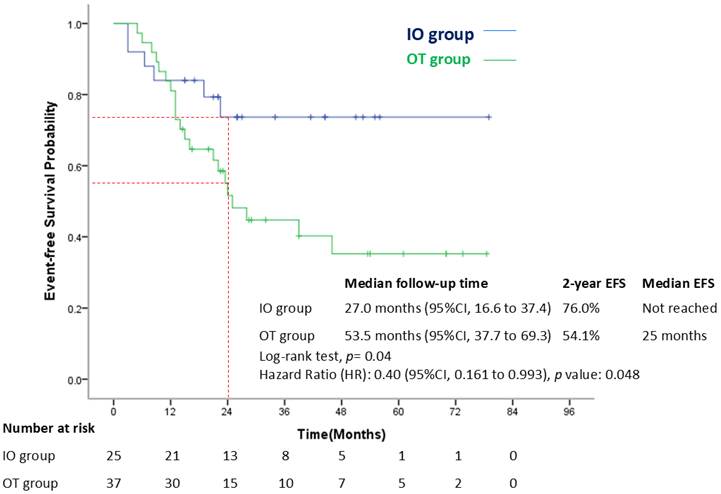
As illustrated in Figure 1, the IO group demonstrated a significantly better EFS than the OT group. The 2-year EFS rate was substantially higher in the IO group (76.0%) than in the OT group (54.1%). The median follow-up times were 27.0 months (95% CI: 16.6-37.4) for the IO group and 53.5 months (95% CI: 37.7-69.3) for the OT group. The median EFS was not reached in the IO group, whereas it was 25.0 months (95% CI: 17.6-32.4) in the OT group (log-rank test, p = 0.04). Furthermore, Cox proportional hazard regression analysis confirmed a significant difference, with a hazard ratio (HR) of 0.40 (95% CI: 0.161-0.993, p = 0.048), indicating a significantly lower risk of events in the IO group.
Kaplan-Meier Curve of Event-Free Survival (EFS) by Treatment. The figure shows EFS probability over time (in months) for the neoadjuvant immunotherapy (IO group, blue line) and other therapy (OT group, green line) group. Statistically significant separation between the survival curves was observed (Log-rank test, p = 0.04). The IO group demonstrated a significantly lower risk of events compared to the OT group (HR = 0.40, 95% CI: 0.161 to 0.993, p = 0.048). The median follow-up time was 27.0 months (95% CI: 16.6 to 37.4) for the IO group and 53.5 months (95% CI: 37.7 to 69.3) for the OT group; 2-year EFS rates were 76.0% and 54.1% respectively. Median EFS was not reached for the IO group but was 25 months for the OT group. CI, confidence interval; EFS, event-free survival; HR, hazard ratio; IO, immunotherapy; OT, other therapy.
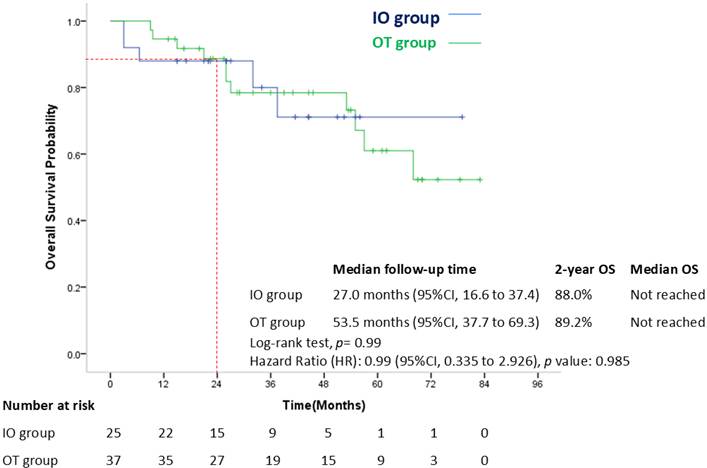
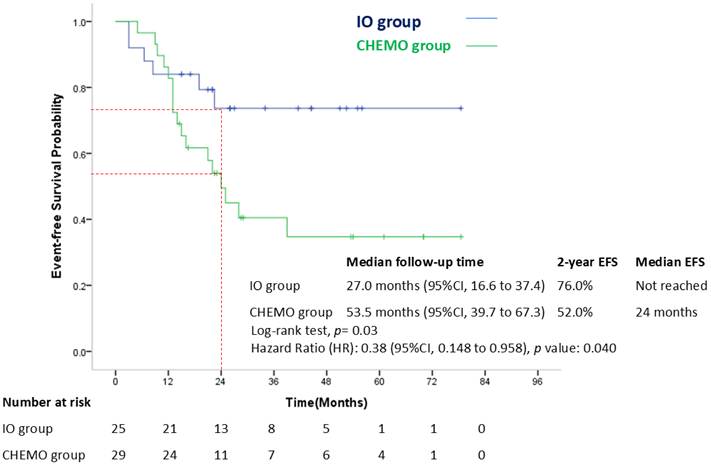
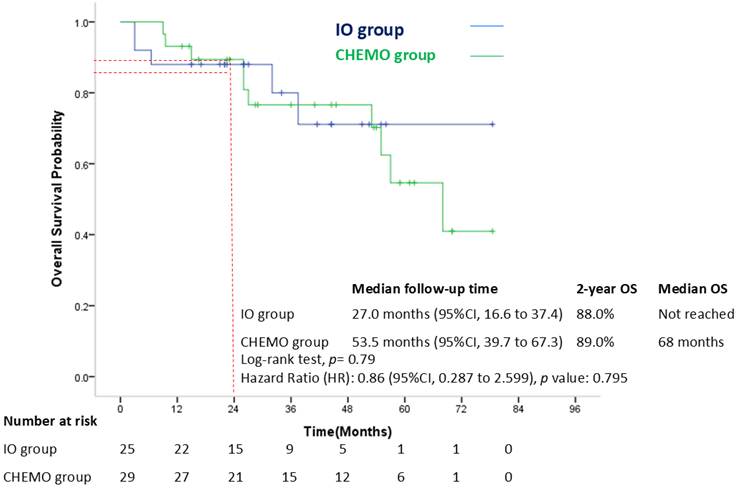
As shown in Figure 2, the 2-year OS rates were comparable between the IO and OT groups (88.0% and 89.2%, respectively). The median follow-up times were 27.0 months (95% CI: 16.6-37.4) for the IO group and 53.5 months (95% CI: 37.7-69.3) for the OT group. The median OS was not reached in either group. The Kaplan-Meier analysis revealed no statistically significant difference in OS between the two groups (log-rank test, p = 0.99). Consistent with this finding, the Cox proportional hazard regression analysis yielded an HR of 0.99 (95% CI: 0.335-2.926, p = 0.985), indicating no significant difference in the risk of death between the treatment groups. A subgroup analysis was performed by restricting the control arm strictly to patients who received chemotherapy alone (n = 29). The IO group continued to demonstrate significantly superior EFS compared to the chemotherapy-alone cohort (HR = 0.38, 95% CI: 0.148-0.958, p = 0.040) (Figure 3). Furthermore, no significant difference in OS was observed between the IO and chemotherapy-alone groups (Figure 4).
Kaplan-Meier Curve of Overall Survival (OS) by Treatment. The figure illustrates the OS probability over time (in months) for patients receiving neoadjuvant IO group (blue line) and OT group (green line). There was no statistically significant difference in OS between the two groups (Log-rank test, p = 0.99). The HR was 0.99 (95% CI: 0.335 to 2.926, p = 0.985). The median follow-up time was 27.0 months (95% CI: 16.6 to 37.4) for the IO group and 53.5 months (95% CI: 37.7 to 69.3) for the OT group. The 2-year OS rates were comparable between the cohorts (88.0% for IO vs. 89.2% for OT). CI, confidence interval; HR, hazard ratio; IO, immunotherapy; OS, overall survival; OT, other therapy.
Kaplan-Meier Curve of Event-Free Survival (EFS) by Treatment. The figure shows EFS probability over time (in months) for the neoadjuvant immunotherapy (IO group, blue line) and chemotherapy only (CHEMO group, green line) group. Statistically significant separation between the survival curves was observed (Log-rank test, p = 0.03). The IO group demonstrated a significantly lower risk of events compared to the CHEMO group (HR = 0.38, 95% CI: 0.148 to 0.958, p = 0.040). The median follow-up time was 27.0 months (95% CI: 16.6 to 37.4) for the IO group and 53.5 months (95% CI: 39.7 to 67.3) for the CHEMO group; 2-year EFS rates were 76.0% and 52.0% respectively. Median EFS was not reached for the IO group but was 24 months for the CHEMO group. CHEMO, chemotherapy; CI, confidence interval; EFS, event-free survival; HR, hazard ratio; IO, immunotherapy.
Kaplan-Meier Curve of Overall Survival (OS) by Treatment. The figure illustrates the OS probability over time (in months) for patients receiving neoadjuvant IO group (blue line) and CHEMO group (green line). There was no statistically significant difference in OS between the two groups (Log-rank test, p = 0.79). The HR was 0.86 (95% CI: 0.287 to 2.599, p = 0.795). The median follow-up time was 27.0 months (95% CI: 16.6 to 37.4) for the IO group and 53.5 months (95% CI: 39.7 to 67.3) for the CHEMO group. The 2-year OS rates were comparable between the cohorts (88.0% for IO vs. 89.0% for CHEMO). CHEMO, chemotherapy; CI, confidence interval; HR, hazard ratio; IO, immunotherapy; OS, overall survival.
3.4. Prognostic factors for EFS
Univariate and multivariate Cox proportional hazard regression analyses were performed to identify potential prognostic factors associated with EFS, as summarized in Table 3. The univariate analysis demonstrated that the administration of neoadjuvant IO was the only factor significantly associated with prolonged EFS (HR = 0.40, 95% CI: 0.16-0.99, p = 0.048). Other baseline clinical characteristics, including age, sex, clinical stage, PD-L1 expression, histology, and receipt of adjuvant therapy, did not show statistically significant associations with EFS. Crucially, a multivariate Cox regression model was subsequently constructed to adjust for potential confounding variables, including age, sex, stage, PD-L1 expression, and histology. The multivariate analysis confirmed that neoadjuvant IO remained a strong and independent protective factor for EFS (adjusted HR = 0.34, 95% CI: 0.12-0.92, p = 0.034).
Univariate and multivariate Cox proportional hazards regression analyses identified potential prognostic factors associated with event-free survival.
| EFS univariate Cox analysis | EFS multivariate Cox analysis | |||||
|---|---|---|---|---|---|---|
| HR | 95% CI | P value | Adjusted HR | 95% CI | P value | |
| Age | ||||||
| > 65 years old | Ref. | |||||
| < 65 years old | 0.66 | 0.31-1.43 | 0.297 | 0.61 | 0.27-1.43 | 0.236 |
| Sex | ||||||
| Male | Ref. | |||||
| Female | 0.64 | 0.28-1.46 | 0.285 | 0.73 | 0.29-1.86 | 0.515 |
| Stage | ||||||
| Stage I-II | Ref. | |||||
| Stage III | 1.10 | 0.42-2.92 | 0.839 | 1.21 | 0.42-3.52 | 0.724 |
| PD-L1 | ||||||
| < 50% | Ref. | |||||
| > 50% | 0.99 | 0.38-2.63 | 0.992 | 1.31 | 0.44-3.92 | 0.634 |
| Histology | ||||||
| Non-adenocarcinoma | Ref. | |||||
| Adenocarcinoma | 0.68 | 0.30-1.53 | 0.353 | 0.59 | 0.24-1.45 | 0.247 |
| Neoadjuvant therapy | ||||||
| OT | Ref. | |||||
| IO | 0.40 | 0.16-0.99 | 0.048 | 0.34 | 0.12-0.92 | 0.034 |
| Adjuvant therapy | ||||||
| No | Ref. | |||||
| Yes | 1.34 | 0.56-3.16 | 0.512 | 1.49 | 0.61-3.58 | 0.380 |
Abbreviation: CI, confidence interval; EFS, Event-free survival; HR, hazard ratio; IO, Immunotherapy; OT, other therapy; PD-L1, programmed death-ligand 1
3.5. Patient characteristics from the TriNetX database
Data extracted from the TriNetX database was divided into a chemotherapy alone (CT) group (n = 979) and a chemotherapy combined with IO (CT with IO) group (n = 425). Before propensity score matching (PSM) was performed, the two cohorts exhibited significant differences in demographic characteristics and clinical comorbidities (Table 4). The CT with IO group was significantly older than the CT group (mean age: 66.4 ± 8.1 vs. 60.6 ± 13.2 years, p < 0.001) and possessed a higher mean BMI (28.0 ± 5.9 vs. 26.7 ± 5.8 kg/m², p < 0.001). While both groups were predominantly White, significant differences were observed in the proportions of White patients (p < 0.001) and patients of other races (p = 0.025). In terms of underlying comorbidities, the CT with IO group had a significantly higher prevalence of COPD, hypertension, CAD, and CVA (p < 0.001). No statistically significant differences were observed prior to matching in terms of gender, FEV1, liver disease, diabetes mellitus, or CEA levels.
The Demographic Characteristics of each Group from TriNetX database
| All patients | Propensity score matching patients | ||||||
|---|---|---|---|---|---|---|---|
| CT (n = 979) | CT with IO (n = 425) | p | CT (n = 404) | CT with IO (n = 404) | p | ||
| Age (years old) | < 0.001 | 0.396 | |||||
| Mean ± SD | 60.6 ±13.2 | 66.4 ± 8.1 | 66.5±8.9 | 66.0 ± 8.0 | |||
| Sex | 0.548 | 0.673 | |||||
| Male | 487 (49.75%) | 204 (48.00%) | 191 (47.28%) | 197 (48.76%) | |||
| Female | 492 (50.25%) | 221 (52.00%) | 213 (52.72%) | 207 (51.24%) | |||
| BMI (kg/m2) | < 0.001 | 0.190 | |||||
| Mean ± SD | 26.7 ±5.8 | 28.0± 5.9 | 27.3 ± 6.0 | 27.9 ± 5.8 | |||
| Race | |||||||
| White | 707 (72.22%) | 343 (80.71%) | < 0.001 | 319 (78.96%) | 323 (79.95%) | 0.728 | |
| Black | 89 (9.09%) | 38 (8.94%) | 0.928 | 33 (8.17%) | 38 (9.41%) | 0.534 | |
| Asian | 48 (4.90%) | 13 (3.06%) | 0.119 | 10 (2.48%) | 12 (2.97%) | 0.666 | |
| Other | 135 (13.79%) | 31 (7.29%) | 0.025 | 42 (10.39%) | 31 (7.67%) | 0.526 | |
| FEV1(Liter) | 0.251 | 0.940 | |||||
| Mean ± SD | 2.5 ± 0.9 | 2.3 ± 0.7 | 2.4 ± 0.8 | 2.3 ± 0.7 | |||
| COPD | 363 (37.08%) | 249 (58.59%) | < 0.001 | 213 (52.72%) | 230 (56.93%) | 0.230 | |
| Hypertension | 516 (52.71%) | 265 (62.35%) | < 0.001 | 249 (61.63%) | 251 (62.13%) | 0.885 | |
| CAD | 238 (24.31%) | 164 (38.59%) | < 0.001 | 147 (36.39%) | 147 (36.39%) | 1.000 | |
| CVA | 130 (13.28%) | 101 (23.77%) | < 0.001 | 86 (21.29%) | 87 (21.54%) | 0.932 | |
| Liver disease | 216 (22.06%) | 74 (17.41%) | 0.048 | 64 (15.84%) | 74 (18.32%) | 0.350 | |
| Diabetes mellitus | 210 (21.45%) | 100 (23.53%) | 0.388 | 103 (25.50%) | 95 (23.52%) | 0.513 | |
| CEA | 0.812 | 0.444 | |||||
| Mean ± SD | 9.7 ±34.0 | 8.2 ± 13.6 | 13.7 ± 49.2 | 7.0 ± 11.6 | |||
| IO | |||||||
| Nivolumab | 263 (61.88%) | 252 (62.37%) | |||||
| Pembrolizumab | 151 (35.53%) | 142 (35.15%) | |||||
| Durvalumab | 11 (2.59%) | 10 (2.48%) | |||||
| Atezolizumab | 0 (0.00%) | 0 (0.00%) | |||||
Abbreviation: BMI, body mass index; CAD, Coronary artery disease; CEA, Carcinoembryonic antigen; COPD, Chronic Obstructive Pulmonary Disease; CT, chemotherapy; CVA, Cerebrovascular accident; FEV1, Forced expiratory volume in 1 second; IO, Immunotherapy; SD, Standard Deviation
PSM was performed to adjust for baseline confounding factors, resulting in 404 patients in the matched CT and CT with IO groups. After matching, the baseline characteristics achieved excellent balance, with no significant differences observed in age, sex, BMI, racial distribution, or FEV1. Similarly, all evaluated comorbidities, including COPD, hypertension, CAD, CVA, liver disease, diabetes mellitus, and CEA values, showed no significant differences between the two groups and resulted in a high degree of statistical comparability. Regarding the distribution of IO agents in the matched CT with IO cohort (n = 404), nivolumab was the most frequently administered drug (63.37%), followed by pembrolizumab (35.15%). Few of these patients received durvalumab (2.48%) or atezolizumab (0.00%) (Table 4).
3.6. OS from the TriNetX database
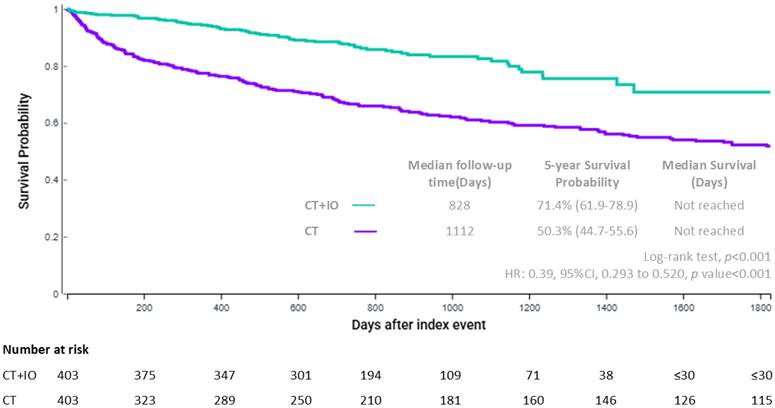
As shown in Figure 5, the Kaplan-Meier survival analysis demonstrated a significantly longer OS for patients receiving CT + IO than those receiving CT alone. The median survival time were not reached in either group, with 5-year OS rates of 71.38% and 50.29%, respectively. The difference in survival probabilities between the two cohorts was highly significant (log-rank test, p < 0.001). Furthermore, the HR was 0.39 (95% CI: 0.293-0.520, p < 0.001), indicating a significant difference in the risk of events between the treatment groups.
Kaplan-Meier Curve of Overall Survival (OS) in the Propensity Score-Matched TriNetX database. The graph illustrates the survival probability over time (in days) for patients receiving neoadjuvant CT+ IO (cyan line) compared to those receiving CT (purple line). A highly significant separation between the survival curves was observed, favoring the CT+ IO group (Log-rank test, p < 0.001). Cox regression analysis revealed a significantly reduced risk of mortality by 61% (HR = 0.39, 95% CI: 0.293 to 0.520, p < 0.001). Median follow-up time was 828 days for the CT+ IO group and 1112 days for the CT group. The overall survival rate was notably higher in the CT+ IO cohort (71.38%) compared to the CT cohort (50.29%). Numbers at risk were reconstructed from the Kaplan-Meier estimates exported from TriNetX, which does not report risk sets and values indicate patients at risk at the first death on or after each time point. In the CT+IO cohort, the last death occurred on day 1,472 (30 patients at risk), and subsequent risk sets are shown as ≤30. One patient in each cohort was excluded from the survival analysis by TriNetX because the outcome occurred before the time window.
4. Discussion
The data demonstrated a striking disparity in treatment response. The MPR rates reached 52.0% in the IO group and 10.8% in the OT group, with 32.0% of patients in the IO group achieving a pCR compared with 0.0% in the OT group. In the 2-year follow-up of the cohort, the IO group demonstrated a statistically significantly higher rate of EFS (76.0% vs. 54.1%, p = 0.04).
Importantly, these compelling pathological and survival outcomes in the real-world cohort align closely with established benchmarks from clinical trials evaluating neoadjuvant chemo-IO in resectable NSCLC. For instance, the CheckMate 816 trial reported a pCR rate of 24.0% and an MPR rate of 36.9% in the nivolumab plus chemotherapy arm [6]. Similarly, the phase II NADIM II trial demonstrated a pCR of 37% and an MPR of 53% [12]. Real-world data from China showed 60.1% of patients achieved MPR and 39.2% achieved pCR following neoadjuvant chemo-IO [13]. While landmark trials often enforce stringent eligibility criteria, the single-center experience in the present study highlights that even patients presenting with borderline resectable tumors due to extensive local invasion can attain comparable therapeutic benefits. Two patients at stage IIIC in the IO group achieved pCR, and one patient achieved MPR. This profound downstaging not only facilitated parenchyma-sparing surgery in anatomically complex cases but also underscored the broader generalizability of the neoadjuvant IO regimen in clinical practice, providing clinicians with strong dual assurances of safety and efficacy when evaluating neoadjuvant therapies.
The significant 2-year EFS advantage observed in the IO cohort is consistent with the survival benefits reported in these landmark trials. Specifically, the 2-year EFS rates for the chemo-IO arms were reported as 63.8% in CheckMate 816, 67.2% in NADIM II and 62.4% in the perioperative KEYNOTE-671 trial [6, 7, 12]. The AEGEAN and CheckMate 77T trials reported 2-year EFS rates of approximately 63.3%-65% [8, 9]. While CheckMate 816 and KEYNOTE-671 recently demonstrated a significant OS benefit, the lack of a statistically significant OS difference at 2 years in the present study is possibly attributable to the relatively short follow-up duration inherent to the current dataset. Continual follow-up of the cohort is essential to determine if the EFS benefits can translate into OS advantage.
The NADIM II trial demonstrated that baseline PD-L1 positivity (≥ 1%) in the experimental arm was a significant predictor of pCR (relative risk: 3.56, 95% CI: 1.19-10.63), an outcome strongly associated with improved progression-free survival. Although baseline PD-L1 expression was positive in 84.0% of patients in the IO group compared to only 40.5% in the OT group (p = 0.001), PD-L1 status in our IO group did not significantly predict the achievement of MPR (relative risk: 1.50, 95% CI: 0.48-4.65, p = 0.483) or pCR (relative risk: 0.75, 95% CI: 0.21-2.66, p = 0.656). Similarly, our survival analysis revealed that baseline PD-L1 status was not a significant prognostic factor for EFS (p = 0.634). This lack of significant correlation across both pathological and survival endpoints in our cohort is likely multifactorial. Primarily, the small sample size of our IO group (n = 25) combined with a disproportionately high rate of PD-L1 positivity (84%) resulted in insufficient statistical power, as evidenced by the wide confidence intervals. Furthermore, the absolute predictive value of PD-L1 for neoadjuvant IO remains an evolving subject in the literature. In exploratory analyses of the LCMC3 trial, a pre-treatment peripheral blood immunophenotype comprising 14 immune cell subsets predicted MPR following neoadjuvant atezolizumab monotherapy (AUC 0.72 in an independent test set). Notably, several of these subsets were defined by inhibitory receptors of non-classical HLA pathways: higher baseline levels of NK and NK-like T cells, including ILT2⁺NKG2A⁺ subsets, were associated with a lack of MPR, whereas ILT2-expressing non-T/non-NK cells, possibly of myeloid lineage, were positively associated with MPR [14]. Nevertheless, as early-phase studies have just begun to explore this axis, robust clinical data currently remain sparse and further large-scale prospective evidence from these ongoing studies is required to validate these non-classical pathways as definitive therapeutic targets. [15] Taken together, while PD-L1 remains an important stratification factor, it should not serve as an exclusive biomarker to preclude patients with early-stage NSCLC from receiving neoadjuvant chemo-immunotherapy.
This study incorporated the large TriNetX database to overcome the limitations of a single institution. After PSM was performed to adjust for baseline confounding factors such as age, BMI, and clinical comorbidities, the matched groups achieved excellent balance and a high degree of statistical comparability. The results showed that the OS rate in the CT with IO group was significantly better than that of the CT group. Furthermore, the HR (0.39) indicated a significant difference in the risk of death between the treatment groups. By applying a longer observation window of 1,825 days (5 years), the TriNetX analysis provided complementary data on longer-term OS that could not be assessed within the follow-up of our single-institution cohort. Although the observation window extended to 5 years, the median follow-up in the CT+IO cohort was 828 days, and fewer than 30 patients remained at risk beyond approximately 4 years. The shorter follow-up in the CT+IO cohort also reflects the more recent adoption of neoadjuvant immunotherapy, and temporal differences in perioperative care may have contributed to the observed survival difference. The hazard ratio should therefore be regarded as an average effect over the observation period and confirmation in prospective studies with longer follow-up is warranted. Additionally, a notable demographic distinction must be considered: the TriNetX database is composed largely of Western populations (approximately 70%), whereas the present study represents an Asian demographic. The aligned outcomes across these different cohorts imply that the clinical benefits of neoadjuvant IO are likely applicable across diverse ethnic backgrounds.
Conversely, no patient treated with targeted therapy in the OT group could achieve MPR or pCR. Similarly, while the phase III NeoADAURA trial demonstrated a significant improvement in MPR with neoadjuvant osimertinib compared to chemotherapy (25%-26% vs. 2%), it still reported a low possibility of achieving a pCR (4%-9% vs. 0%). Furthermore, long-term survival data remain immature (15% data maturity), leaving it unclear whether this MPR advantage translates into definitive EFS and OS benefits [16]. A retrospective cohort study evaluating neoadjuvant TKI monotherapy in resectable EGFR-mutant NSCLC similarly reported a 0% pCR rate in the targeted therapy arm [17]. Furthermore, historical benchmarks, such as the phase II EMERGING-CTONG 1103 trial, previously demonstrated a 0% pCR and only a 9.7% MPR rate with neoadjuvant erlotinib [18]. Given the low pathological response rates generally associated with neoadjuvant EGFR-TKI monotherapy in resectable NSCLC, which may lead to inferior clinical outcomes, we conducted a subgroup analysis to reduce potential confounding by targeted therapies. The clinical outcomes of this restricted analysis were highly consistent with the primary EFS results.
Neoadjuvant treatment with immune checkpoint inhibitors and chemotherapy often induces dense fibrosis due to peri-tumoral inflammation, which increases the technical complexity of the subsequent resection [19]. However, the incidence of postoperative complications remained acceptable [20]. Previous literature has demonstrated that age, baseline blood urea nitrogen levels, and N2 nodal status serve as excellent predictors of postoperative pulmonary complications in patients undergoing resection after neoadjuvant therapy [21]. Consistent with previous findings, the single-institution analysis showed no significant differences between the IO group and the OT group in terms of surgical time, length of hospital stay, blood loss, and conversion rates to thoracotomy.
Previous studies elaborated that neoadjuvant chemo-IO increases the possibility of R0 resection [22, 23]. Either open or minimally invasive surgery (thoracoscopy or robotic surgery) is able to achieve a complete resection in up to 90% of patients [19, 24]. The CheckMate 816 trial emphasized the clinical benefits of parenchyma-sparing surgery and the avoidance of pneumonectomy, which carries a higher risk of postoperative morbidity than other pulmonary resections [5, 25]. None of the patients in the present cohort underwent pneumonectomy. Beyond achieving a higher R0 resection rate and avoiding pneumonectomy, the ultimate determinant of neoadjuvant treatment success is the pathological response [26].
Several limitations in this study must be acknowledged. First, the single-center cohort was analyzed retrospectively, which inevitably introduced selection bias. Second, although the TriNetX database partially compensated for the limited sample size and short follow-up of the institutional cohort, large-scale electronic health record networks lack granular clinical information. Detailed operative findings, pathological staging, and pathological response were not reliably available. Consequently, the TriNetX cohort could be used to evaluate survival outcomes but not pathological response. Because operative details could not be verified, the TriNetX cohort was restricted to patients with procedure codes for standard lobectomy, whereas the institutional cohort also included a small proportion of extended and sublobar resections. Furthermore, retrospective extraction of continuous laboratory variables, such as CEA levels, presents inherent challenges. In Table 4, CEA values exhibited extreme variance. This high variability is a well-known limitation of databases, likely stemming from unstandardized measurement units, extreme outliers, and a lack of precise temporal synchronization. Third, limitations regarding molecular and biomarker data must be acknowledged. In this real-world study, comprehensive genetic profiling (such as EGFR, ALK, and KRAS mutation testing) was not universally performed for all patients, leading to incomplete baseline genetic data. Furthermore, the role of dynamic biomarker assessment, such as circulating tumor DNA, cannot be addressed. Integrating these blood-based assays into future prospective trials is crucial for overcoming the predictive blind spots of conventional tissue biopsies.
5. Conclusion
This study demonstrated that real-world neoadjuvant chemo-IO provides strong dual assurances of surgical safety and profound oncological efficacy, highlighted by superior MPR, pCR, and EFS rates compared with conventional therapies. By integrating the TriNetX database, this study confirmed the significant OS advantage of neoadjuvant chemo-IO.
Competing Interests
The authors have declared that no competing interest exists.
References
1. Sung H, Ferlay J, Siegel RL, Laversanne M, Soerjomataram I, Jemal A. et al. Global Cancer Statistics 2020: GLOBOCAN Estimates of Incidence and Mortality Worldwide for 36 Cancers in 185 Countries. CA Cancer J Clin. 2021;71:209-49
2. Siegel RL, Giaquinto AN, Jemal A. Cancer statistics, 2024. CA Cancer J Clin. 2024;74:12-49
3. Herbst RS, Morgensztern D, Boshoff C. The biology and management of non-small cell lung cancer. Nature. 2018;553:446-54
4. Pilon Y, Rokah M, Seitlinger J, Sepesi B, Rayes RF, Cools-Lartigue J. et al. Transitioning to Neoadjuvant Therapy for Resectable Non-Small Cell Lung Cancer: Trends and Surgical Outcomes in a Regionalized Pulmonary Oncology Network. Clin Lung Cancer. 2024;25:e133-e44
5. Forde PM, Spicer J, Lu S, Provencio M, Mitsudomi T, Awad MM. et al. Neoadjuvant Nivolumab plus Chemotherapy in Resectable Lung Cancer. N Engl J Med. 2022;386:1973-85
6. Forde PM, Spicer JD, Provencio M, Mitsudomi T, Awad MM, Wang C. et al. Overall Survival with Neoadjuvant Nivolumab plus Chemotherapy in Lung Cancer. The New England journal of medicine. 2025;393:741-52
7. Spicer JD, Garassino MC, Wakelee H, Liberman M, Kato T, Tsuboi M. et al. Neoadjuvant pembrolizumab plus chemotherapy followed by adjuvant pembrolizumab compared with neoadjuvant chemotherapy alone in patients with early-stage non-small-cell lung cancer (KEYNOTE-671): a randomised, double-blind, placebo-controlled, phase 3 trial. Lancet. 2024;404:1240-52
8. Cascone T, Awad MM, Spicer JD, He J, Lu S, Sepesi B. et al. Perioperative Nivolumab in Resectable Lung Cancer. N Engl J Med. 2024;390:1756-69
9. Heymach JV, Harpole D, Mitsudomi T, Taube JM, Galffy G, Hochmair M. et al. Perioperative Durvalumab for Resectable Non-Small-Cell Lung Cancer. N Engl J Med. 2023;389:1672-84
10. Rizvi N, Gandara D, Solomon B, Kim A, Brunelli A, Sun S, et al. P2.17-27 IMpower030: Phase III Study Evaluating Neoadjuvant Treatment of Resectable Stage II-IIIB NSCLC with Atezolizumab + Chemotherapy. Journal of Thoracic Oncology. 2018; 13
11. Travis WD, Dacic S, Wistuba I, Sholl L, Adusumilli P, Bubendorf L. et al. IASLC Multidisciplinary Recommendations for Pathologic Assessment of Lung Cancer Resection Specimens After Neoadjuvant Therapy. J Thorac Oncol. 2020;15:709-40
12. Provencio M, Nadal E, Gonzalez-Larriba JL, Martinez-Marti A, Bernabe R, Bosch-Barrera J. et al. Perioperative Nivolumab and Chemotherapy in Stage III Non-Small-Cell Lung Cancer. N Engl J Med. 2023;389:504-13
13. Wang X, Wang X, Hui B, Cai J, Zhao H, Qiao B. et al. Efficacy of neoadjuvant chemo-immunotherapy in non-small cell lung cancer: a real-world, multicenter, retrospective study. Transl Lung Cancer Res. 2024;13:849-60
14. Chaft JE, Oezkan F, Kris MG, Bunn PA, Wistuba, II, Kwiatkowski DJ. et al. Neoadjuvant atezolizumab for resectable non-small cell lung cancer: an open-label, single-arm phase II trial. Nat Med. 2022;28:2155-61
15. Beers C, Ilaria RL, Luke JJ. Unlocking the promise of innate biology through the HLA-G/ILT2/ILT4 pathway. J Immunother Cancer. 2026 14
16. He J, Tsuboi M, Weder W, Chen KN, Hochmair MJ, Shih JY. et al. Neoadjuvant Osimertinib for Resectable EGFR-Mutated Non-Small Cell Lung Cancer. J Clin Oncol. 2025;43:2875-87
17. Shao W, Liu Z, Li B, Chen F, Liu J, Li H. et al. Neoadjuvant targeted therapy versus targeted combined with chemotherapy for resectable EGFR-mutant non-small cell lung cancer: a retrospective controlled real-world study. Front Oncol. 2024;14:1349300
18. Zhong WZ, Yan HH, Chen KN, Chen C, Gu CD, Wang J. et al. Erlotinib versus gemcitabine plus cisplatin as neoadjuvant treatment of stage IIIA-N2 EGFR-mutant non-small-cell lung cancer: final overall survival analysis of the EMERGING-CTONG 1103 randomised phase II trial. Signal Transduct Target Ther. 2023;8:76
19. El Husseini K, Piton N, De Marchi M, Gregoire A, Vion R, Blavier P. et al. Lung Cancer Surgery after Treatment with Anti-PD1/PD-L1 Immunotherapy for Non-Small-Cell Lung Cancer: A Case-Cohort Study. Cancers (Basel). 2021 13
20. Bai G, Chen X, Peng Y, Ji Y, Bie F, Liu Y. et al. Surgery challenges and postoperative complications of lung cancer after neoadjuvant immunotherapy. Thorac Cancer. 2024;15:1138-48
21. Zhang H, Mao X, Xu J, Song L, Huang Z, Li Y. et al. Risk factors for postoperative pulmonary complications in non-adenocarcinoma non-small cell lung cancer patients undergoing surgery after neoadjuvant therapy. Transl Lung Cancer Res. 2025;14:552-62
22. Aburaki R, Fujiwara Y, Chida K, Horita N, Nagasaka M. Surgical and safety outcomes in patients with non-small cell lung cancer receiving neoadjuvant chemoimmunotherapy versus chemotherapy alone: A systematic review and meta-analysis. Cancer Treat Rev. 2024;131:102833
23. Sorin M, Prosty C, Ghaleb L, Nie K, Katergi K, Shahzad MH. et al. Neoadjuvant Chemoimmunotherapy for NSCLC: A Systematic Review and Meta-Analysis. JAMA Oncol. 2024;10:621-33
24. Noy J, Chang A, Chow NP, De Jesus Fernandez J, Dureja R, Cotamo LM. et al. Outcomes of Resectable Locally Advanced Non-Small Cell Lung Cancer After Neoadjuvant Chemoimmunotherapy: A Single Institution Experience. J Clin Med. 2025 14
25. Teng M, Yi C, Yang W, Zhang J, Yao W, Hu S. et al. Sleeve lobectomy versus pneumonectomy following neoadjuvant therapy in patients with non-small cell lung cancer. Eur J Cardiothorac Surg. 2024;66:ezae300
26. Deutsch JS, Cimino-Mathews A, Thompson E, Provencio M, Forde PM, Spicer J. et al. Association between pathologic response and survival after neoadjuvant therapy in lung cancer. Nat Med. 2024;30:218-28
Author contact
Corresponding authors: Shun-Fa Yang, PhD., or Jeng-Sen Tseng, MD, Institute of Medicine, Chung Shan Medical University, 110, Section 1, Chien-Kuo North Road, Taichung, 40201, Taiwan. Tel.: 886-4-24739595 ext. 34253; Fax: 884-4-24738493 E-mail: ysfedu.tw (Shun-Fa Yang); tzeng64com (Jeng-Sen Tseng).