Impact Factor ISSN: 1837-9664




J Cancer 2026; 17(8):1463-1469. doi:10.7150/jca.137994 This issue Cite
Research Paper
Potential influence of long non-coding RNA NEAT1 genetic variants and expression levels on the progression of prostate cancer
Cheng-En Mei1,2, Chia-Yen Lin2,3, Shian-Shiang Wang2, Shih-Chi Su4,5, Heng-Hsiung Wu6, Lun-Ching Chang7, Chih-Hsin Tang8,9,10  , Shun-Fa Yang1,11
1. Institute of Medicine, Chung Shan Medical University, Taichung, Taiwan
2. Department of Urology, Taichung Veterans General Hospital, Taichung, Taiwan
3. School of Medicine, Chung Shan Medical University, Taichung, Taiwan
4. Whole-Genome Research Core Laboratory of Human Diseases, Chang Gung Memorial Hospital, Keelung, Taiwan
5. Department of Medical Biotechnology and Laboratory Science, College of Medicine, Chang Gung University, Taoyuan, Taiwan
6. Program for Cancer Biology and Drug Discovery, China Medical University, Taichung, Taiwan
7. Department of Mathematics and Statistics, Florida Atlantic University, Florida, USA
8. Department of Pharmacology, School of Medicine, China Medical University, Taichung, Taiwan
9. Department of Medical Laboratory Science and Biotechnology, Asia University, Taichung, Taiwan
10. Chinese Medicine Research Center, China Medical University, Taichung, Taiwan
11. Department of Medical Research, Chung Shan Medical University Hospital, Taichung, Taiwan
Received 2026-5-19; Accepted 2026-7-29; Published 2026-8-10
Abstract
Prostate cancer is a leading malignancy in men worldwide, with disease aggressiveness varying widely among patients. Long non-coding RNA NEAT1 has emerged as a key regulator of tumor progression, yet the impact of its genetic variants on prostate cancer susceptibility and aggressiveness remains unclear. In this study, we investigated the association of NEAT1 polymorphisms with clinicopathological features in 693 prostate cancer patients. Patients were stratified by PSA levels (≤ 10 ng/mL vs. > 10 ng/mL), and genotypes of NEAT1 rs3741384, rs512715, and rs3825071 were determined. Among the analyzed NEAT1 SNPs, rs3825071 was significantly associated with PSA levels and perineural invasion in patients with prostate cancer. In the high-PSA subgroup, carriers of the CT and TT genotypes exhibited a lower likelihood of elevated PSA (> 10 ng/mL) (AOR = 0.794, p = 0.011) and a reduced risk of perineural invasion (OR = 0.470, p = 0.007). Functional analyses using the GTEx and TCGA datasets revealed genotype-dependent alterations in NEAT1 expression, with significant upregulation observed in prostate cancer tissues, particularly in cases with higher Gleason scores and lymph node metastasis. Collectively, our results suggest that NEAT1 rs3825071 T alleles confer a protective effect and highlight its potential as a genetic biomarker for prostate cancer progression.
Keywords: NEAT1, long non-coding RNA (lncRNA), genetic polymorphism, perineural invasion, PSA.
1. Introduction
Prostate cancer is one of the most common malignant tumors in men worldwide and is a major cause of cancer-related mortality. In the United States alone, approximately 313,780 new cases and 35,770 deaths were reported in 2025, highlighting its substantial global health burden [1]. The risk of prostate cancer increases significantly with age, particularly after 55 years, and marked differences exist among ethnic groups. Although most prostate cancer patients present with localized disease at diagnosis, survival outcomes differ dramatically once the disease becomes metastatic [2, 3].
Serum prostate-specific antigen (PSA) testing remains a central tool for prostate cancer screening and early diagnosis. Its widespread use has significantly increased detection rates and led to more than one million prostate biopsy procedures annually[4]. However, PSA has limited specificity in distinguishing clinically significant cancer from indolent lesions, especially in patients with PSA levels below 10 ng/mL, in whom the cancer detection rate is only 22% to 27% [5, 6]. This limitation leads to overdiagnosis, overtreatment, and unnecessary invasive procedures, while still failing to reliably predict tumor aggressiveness or metastatic potential[7-9]. Therefore, it is important to improve the clinical interpretation of PSA and to integrate additional prognostic indicators to enhance risk stratification and optimize the management of prostate cancer.
Long non-coding RNAs (lncRNAs) are transcripts longer than 200 nucleotides that lack protein-coding capacity. In recent years, they have been recognized as key regulators of gene expression, cell cycle progression, differentiation, and tumorigenesis [10-13]. Among these, NEAT1 (nuclear enriched abundant transcript 1) has attracted considerable attention due to its high nuclear abundance and its essential role as a structural scaffold for the formation of paraspeckle nuclear subdomains [14]. Emerging evidence indicates that NEAT1 promotes tumor progression through multiple mechanisms, including miRNA sponging, modulation of signaling pathways, regulation of epithelial-mesenchymal transition (EMT), maintenance of cancer stemness, metabolic reprogramming, and autophagy regulation [15, 16].
NEAT1 is frequently dysregulated across a variety of malignancies, including prostate cancer [14, 17-20]. Recent studies have demonstrated that NEAT1 plays a critical role in prostate cancer, where its dysregulated expression is closely associated with enhanced tumor proliferation, invasion, metastasis, and poor clinical outcomes [21, 22]. For example, NEAT1 is upregulated in prostate cancer and promotes bone metastasis through an N6-methyladenosine (m6A)-dependent mechanism [21]. Furthermore, Xu et al. reported that NEAT1 promotes prostate cancer progression by regulating the miR-582-5p/EZH2 signaling axis [22]. In addition, several single nucleotide polymorphisms (SNPs) in NEAT1, including rs3825071, have been associated with clinicopathological characteristics of tongue cancer and colorectal cancer progression [23, 24]. Moreover, accumulating evidence suggests that NEAT1 polymorphisms, including rs3825071 and rs7943779, may also contribute to gastric cancer susceptibility [25], underscoring their potential clinical significance. Although the functional roles of NEAT1 in prostate cancer have begun to emerge, the impact of its genetic variants on prostate cancer susceptibility has yet to be elucidated. In this study, we performed a hypothesis-driven investigation to examine the association between NEAT1 SNPs and prostate cancer tumorigenesis.
2. Materials and Methods
2.1 Subjects
This retrospective study included 693 patients with prostate cancer who underwent robot-assisted radical prostatectomy with bilateral standard pelvic lymph node dissection at Taichung Veterans General Hospital. The study was approved by the Institutional Review Board (IRB No. CE19062A), and written informed consent was obtained from all participants. Clinical and pathological data, including age at diagnosis, initial PSA level, Gleason score/grade group, TNM stage (AJCC 8th edition), D'Amico risk classification, and pathological features (seminal vesicle, perineural, and lymphovascular invasion), were collected from medical records [26]. Patients were stratified into two groups based on initial PSA level: 330 patients with PSA ≤ 10 ng/mL (PSA ≤ 10 group) and 363 patients with PSA > 10 ng/mL (PSA > 10 group). The cutoff value of 10 ng/mL was selected because it is a clinically established threshold widely used for prostate cancer risk stratification in current clinical practice guidelines.
2.2 Specimen collection and genomic DNA extraction
Genomic DNA was extracted using the QIAamp DNA Blood Mini Kit (Qiagen, Valencia, CA, USA) according to the manufacturer's instructions and stored at -80 °C. DNA quality and concentration were assessed using a Nanodrop-2000 spectrophotometer (Thermo Scientific, Waltham, MA, USA), and high-quality DNA was used as a template for downstream analyses according to previously described [27].
2.3 Selection and Analysis of Neat1 Genetic Polymorphisms
In this study, three NEAT1 SNPs (rs3741384, rs512715, and rs3825071) were selected based on data from the International HapMap Project database and previous studies demonstrating their potential biological significance and associations with cancer susceptibility and progression in various malignancies [23-25]. Genetic polymorphisms of NEAT1 (rs3741384, rs512715, and rs3825071) were genotyped using TaqMan SNP Genotyping Assays (Applied Biosystems) on an ABI StepOnePlus Real-Time PCR System [24]. PCR reactions were performed following standard protocols, and genotypes were analyzed using SDS software.
2.4 Statistical analysis
Continuous and categorical variables were compared using Student's t-test and chi-square or Fisher's exact test, respectively. Associations between genotypes and disease risk or clinicopathological features were evaluated using logistic regression models, with results presented as odds ratios (ORs) or adjusted ORs (AORs) with 95% confidence intervals (CIs), adjusting for age and gender. Statistical analyses were performed using SAS software (version 9.1; SAS Institute, Cary, NC, USA), with p < 0.05 considered statistically significant.
3. Results
3.1 Characteristics of the study participants
A total of 693 patients with prostate cancer were enrolled, including 330 with PSA levels < 10 ng/mL and 363 with PSA levels > 10 ng/mL (Table 1). Patients with PSA > 10 ng/mL were more likely to be older than 65 years (62.8% vs. 51.8%, p = 0.003) and exhibited more aggressive disease characteristics, including higher pathologic Gleason grade group (52.3% vs. 26.4%), advanced clinical T stage (20.4% vs. 6.1%), and increased lymph node involvement at both clinical and pathological levels. In addition, the high PSA group showed significantly higher rates of advanced pathological T stage (61.2% vs. 31.2%), seminal vesicle invasion (32.0% vs. 9.4%), perineural invasion (80.2% vs. 65.8%), lymphovascular invasion (22.9% vs. 8.2%), high-risk D'Amico classification (70.5% vs. 28.2%), and biochemical recurrence (41.6% vs. 20.3%) (all p < 0.001).
The distributions of demographical characteristics in 693 patients with prostate cancer.
| Variable | PSA at diagnosis (ng/ml) | |||
|---|---|---|---|---|
| < 10 (n = 330) | > 10 (n = 363) | p value | ||
| Age at diagnosis (years | ||||
| < 65 | 159 (48.2 %) | 135 (37.2 %) | P = 0.003* | |
| > 65 | 171 (51.8 %) | 228 (62.8 %) | ||
| Pathologic Gleason grade group | ||||
| 1+2 | 243 (73.6 %) | 173 (47.7 %) | P < 0.001* | |
| 3+4+5 | 87 (26.4 %) | 190 (52.3 %) | ||
| Clinical T stage | ||||
| 1+2 | 310 (93.9 %) | 289 (79.6 %) | P < 0.001* | |
| 3+4 | 20 (6.1 %) | 74 (20.4 %) | ||
| Clinical N stage | ||||
| N0 | 327 (99.1 %) | 352 (97.0 %) | P = 0.047* | |
| N1 | 3 (0.9 %) | 11 (3.0 %) | ||
| Pathologic T stage | ||||
| 2 | 227 (68.8 %) | 141 (38.8 %) | P < 0.001* | |
| 3+4 | 103 (31.2 %) | 222 (61.2 %) | ||
| Pathologic N stage | ||||
| N0 | 315 (95.5 %) | 318 (87.6 %) | P < 0.001* | |
| N1 | 15 (4.5 %) | 45 (12.4 %) | ||
| Seminal vesicle invasion | ||||
| No | 299 (90.6 %) | 247 (68.0 %) | P < 0.001* | |
| Yes | 31 (9.4 %) | 116 (32.0 %) | ||
| Perineural invasion | ||||
| No | 113 (34.2 %) | 72 (19.8%) | P < 0.001* | |
| Yes | 217 (65.8 %) | 291 (80.2 %) | ||
| Lymphovascular invasion | ||||
| No | 303 (91.8 %) | 280 (77.1 %) | P < 0.001* | |
| Yes | 27 (8.2 %) | 83 (22.9 %) | ||
| D'Amico classification | ||||
| Low risk/ Intermediate risk | 237 (71.8 %) | 107 (29.5 %) | P < 0.001* | |
| High risk | 93 (28.2 %) | 256 (70.5 %) | ||
| Biochemical recurrence | ||||
| No | 263 (79.7 %) | 212 (58.4 %) | P < 0.001* | |
| Yes | 67 (20.3 %) | 151 (41.6 %) | ||
* p value < 0.05 as statistically significant.
3.2 Association between NEAT1 Polymorphisms and PSA Levels
The distributions of NEAT1 genotypes among patients stratified by PSA levels are shown in Table 2. No significant differences were observed in the genotype frequencies of NEAT1 rs3741384 and rs512715 between the two PSA groups. After adjustment for clinicopathological variables, neither rs3741384 nor rs512715 polymorphisms were significantly associated with PSA levels. In contrast, a significant association was observed for NEAT1 rs3825071. Patients carrying the CT genotype had a significantly lower likelihood of having PSA levels >10 ng/mL compared to those with the CC genotype (AOR = 0.633, 95% CI: 0.438-0.915, p = 0.015). Similarly, individuals with combined CT+TT genotypes also showed a reduced risk (AOR = 0.794, 95% CI: 0.664-0.948, p = 0.011) (Table 2).
Distribution frequency of NEAT1 genotypes in 693 patients with prostate cancer.
| Variable | PSA at diagnosis (ng/ml) | |||
|---|---|---|---|---|
| < 10 (n = 330) | > 10 (n = 363) | AOR (95% CI) | p value | |
| rs3741384 | ||||
| GG | 223 (67.6%) | 255 (70.2%) | 1.000 (reference) | |
| GA | 94 (28.5%) | 101 (27.8%) | 0.918 (0.638-1.319) | P = 0.642 |
| AA | 13 (3.9%) | 7 (2.0%) | 0.489 (0.177-1.357) | P = 0.170 |
| GA+AA | 107 (32.4%) | 108 (29.8%) | 0.931 (0.781-1.110) | P = 0.427 |
| rs512715 | ||||
| GG | 169 (51.2%) | 188 (51.8%) | 1.000 (reference) | |
| GC | 133 (40.3%) | 143 (39.4%) | 0.930 (0.661-1.308) | P = 0.677 |
| CC | 28 (8.5%) | 32 (8.8%) | 1.100 (0.608-1.988) | P = 0.753 |
| GC+CC | 161 (48.8%) | 175 (48.2%) | 0.979 (0.833-1.151) | P = 0.796 |
| rs3825071 | ||||
| CC | 212 (64.2%) | 272 (74.9%) | 1.000 (reference) | |
| CT | 107 (32.4%) | 83 (22.9%) | 0.633 (0.438-0.915) | P = 0.015* |
| TT | 11 (3.3%) | 8 (2.2%) | 0.600 (0.222-1.620) | P = 0.313 |
| CT+TT | 118 (35.8%) | 91 (25.1%) | 0.794 (0.664-0.948) | P = 0.011* |
The adjusted odds ratios (AORs) with their 95% confidence intervals (CIs) were estimated by multiple logistic regression models after controlling for pathologic Gleason grade group, clinical T stage, clinical N stage, pathologic T stage, pathologic N stage, seminal vesicle invasion, perineural invasion, lymphovascular invasion, D'Amico classification and biochemical recurrence.
3.3 Association between NEAT1 rs3825071 Polymorphism and Clinicopathological Characteristics
The associations between NEAT1 rs3825071 polymorphism and clinicopathological characteristics are presented in Table 3. A significant association was observed for perineural invasion. Patients carrying NEAT1 rs3825071 CT+TT genotypes had a significantly lower risk of perineural invasion compared to those with the CC genotype (OR = 0.683, 95% CI: 0.478-0.976, p = 0.036). In contrast, most clinical parameters, including pathologic Gleason grade group, clinical and pathologic T stage, pathologic N stage, seminal vesicle invasion, lymphovascular invasion, D'Amico classification, and biochemical recurrence, were not significantly associated with genotypes.
Odds ratios (ORs) and 95% confidence intervals (CIs) of the clinical status and NEAT1 rs3825071 genotypic frequencies in 693 patients with prostate cancer.
| Variable | rs3825071 | |||
|---|---|---|---|---|
| CC (N = 484) | CT + TT (N = 209) | OR (95% CI) | p value | |
| Pathologic Gleason grade group | ||||
| 1+2 | 284 (58.7%) | 132 (63.2%) | 1.000 | 0.269 |
| 3+4+5 | 200 (41.3%) | 77 (36.8%) | 0.828 (0.593~1.157) | |
| Clinical T stage | ||||
| 1+2 | 414 (85.5%) | 185 (88.5%) | 1.000 | 0.293 |
| 3+4 | 70 (14.5%) | 24 (11.5%) | 0.767 (0.468~1.259) | |
| Pathologic T stage | ||||
| 2 | 249 (51.4%) | 119 (56.9%) | 1.000 | 0.184 |
| 3+4 | 235 (46.6%) | 90 (43.1%) | 0.801 (0.578~1.111) | |
| Pathologic N stage | ||||
| N0 | 447 (92.4%) | 186 (89.0%) | 1.000 | 0.149 |
| N1 | 37 (7.6%) | 23 (11.0%) | 1.494 (0.864~2.584) | |
| Seminal vesicle invasion | ||||
| No | 374 (77.3%) | 172 (82.3%) | 1.000 | 0.138 |
| Yes | 110 (22.7%) | 37 (17.7%) | 0.731 (0.483~1.106) | |
| Perineural invasion | ||||
| No | 118 (24.4%) | 67 (32.1%) | 1.000 | 0.036* |
| Yes | 366 (75.6%) | 142 (67.9%) | 0.683 (0.478~0.976) | |
| Lymphovascular invasion | ||||
| No | 406 (83.9%) | 177 (84.7%) | 1.000 | 0.790 |
| Yes | 78 (16.1%) | 32 (15.3%) | 0.941 (0.601~1.472) | |
| D'Amico classification | ||||
| Low risk/ Intermediate risk | 236 (48.8%) | 108 (51.7%) | 1.000 | 0.481 |
| High risk | 248 (51.2%) | 101 (48.3%) | 0.890 (0.643~1.231) | |
| Biochemical recurrence | ||||
| No | 329 (68.0%) | 146 (69.9%) | 1.000 | 0.625 |
| Yes | 155 (32.0%) | 63 (30.1%) | 0.916 (0.644~1.302) | |
ORs with their 95% CIs were estimated by logistic regression models. * p < 0.05 as statistically significant.
Stratified analyses according to PSA levels are shown in Table 4. Among patients with PSA levels < 10 ng/mL, no significant associations were observed between rs3825071 genotypes and clinicopathological characteristics. In contrast, among patients with PSA levels > 10 ng/mL, the rs3825071 polymorphism was significantly associated with perineural invasion. Patients with CT+TT genotypes had a significantly lower risk of perineural invasion compared to those with the CC genotype (OR = 0.470, 95% CI: 0.271-0.816, p = 0.007). No significant associations were found between rs3825071 polymorphism and other clinicopathological features in either PSA subgroup.
Odds ratios (ORs) and 95% confidence intervals (CIs) of the clinical status and NEAT1 rs3825071 genotypic frequencies in 693 prostate cancer patients with different PSA at diagnosis.
| Variable | PSA at diagnosis < 10 ng/mL (n = 330) | PSA at diagnosis >10 ng/mL (N = 363) | ||||||
|---|---|---|---|---|---|---|---|---|
| CC (N = 212) | CT + TT (N = 118) | OR (95% CI) | p value | CC (N = 272) | CT + TT (N = 91) | OR (95% CI) | p value | |
| Pathologic Gleason grade group | ||||||||
| 1+2 | 162 (76.4%) | 81 (68.6%) | 1.000 | 0.125 | 122 (44.9%) | 51 (56.0%) | 1.000 | 0.064 |
| 3+4+5 | 50 (23.6%) | 37 (31.4%) | 1.480 (0.896~2.444) | 150 (55.1%) | 40 (44.0%) | 0.638 (0.396~1.029) | ||
| Clinical T stage | ||||||||
| 1+2 | 201 (94.8%) | 109 (92.4%) | 1.000 | 0.374 | 213 (78.3%) | 76 (83.5%) | 1.000 | 0.286 |
| 3+4 | 11 (5.2%) | 9 (7.6%) | 1.509 (0.607~3.753) | 59 (21.7%) | 15 (16.5%) | 0.713 (0.382~1.330) | ||
| Pathologic T stage | ||||||||
| 2 | 150 (70.8%) | 77 (65.3%) | 1.000 | 0.301 | 99 (36.4%) | 42 (46.2%) | 1.000 | 0.098 |
| 3+4 | 62 (29.2%) | 41 (34.7%) | 1.288 (0.797~2.084) | 173 (63.6%) | 49 (53.8%) | 0.668 (0.413~1.079) | ||
| Pathologic N stage | ||||||||
| N0 | 206 (97.2%) | 109 (92.4%) | 1.000 | 0.084 | 241 (88.6%) | 77 (84.6%) | 1.000 | 0.318 |
| N1 | 6 (2.8%) | 9 (7.6%) | 2.835 (0.983~8.172) | 31 (11.4%) | 14 (15.4%) | 1.413 (0.715~2.794) | ||
| Seminal vesicle invasion | ||||||||
| No | 194 (91.5%) | 105 (89.0%) | 1.000 | 0.451 | 180 (66.2%) | 67 (73.6%) | 1.000 | 0.187 |
| Yes | 18 (8.5%) | 13 (11.0%) | 1.334 (0.629~2.830) | 92 (33.8%) | 24 (26.4%) | 0.701 (0.413~1.190) | ||
| Perineural invasion | ||||||||
| No | 73 (34.4%) | 40 (33.9%) | 1.000 | 0.922 | 45 (16.5%) | 27 (29.7%) | 1.000 | 0.007* |
| Yes | 139 (65.6%) | 78 (66.1%) | 1.024 (0.637~1.647) | 227 (83.5%) | 64 (70.3%) | 0.470 (0.271~0.816) | ||
| Lymphovascular invasion | ||||||||
| No | 197 (92.9%) | 106 (89.8%) | 1.000 | 0.326 | 209 (76.8%) | 71 (78.0%) | 1.000 | 0.816 |
| Yes | 15 (7.1%) | 12 (10.2%) | 1.487 (0.671~3.292) | 63 (23.2%) | 20 (22.0%) | 0.934 (0.528~1.653) | ||
| D'Amico classification | ||||||||
| Low risk/ Intermediate risk | 158 (74.5%) | 79 (66.9%) | 1.000 | 0.142 | 78 (28.7%) | 29 (31.9%) | 1.000 | 0.563 |
| High risk | 54 (25.5%) | 39 (33.1%) | 1.444 (0.883~2.364) | 194 (71.3%) | 62 (68.1%) | 0.860 (0.514~1.436) | ||
| Biochemical recurrence | ||||||||
| No | 173 (81.6%) | 90 (76.3%) | 1.000 | 0.248 | 156 (57.4%) | 56 (61.5%) | 1.000 | 0.483 |
| Yes | 39 (18.4%) | 28 (23.7%) | 1.380 (0.798~2.388) | 116 (42.6%) | 35 (38.5%) | 0.841 (0.517~1.366) | ||
ORs with their 95% CIs were estimated by logistic regression models. * p < 0.05 as statistically significant.
3.4 Functional and clinical relevance of NEAT1 rs3825071 in prostate cancer
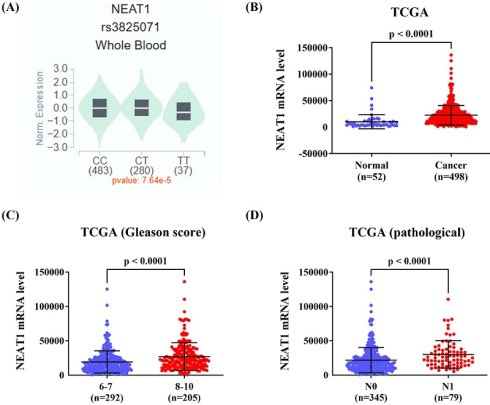
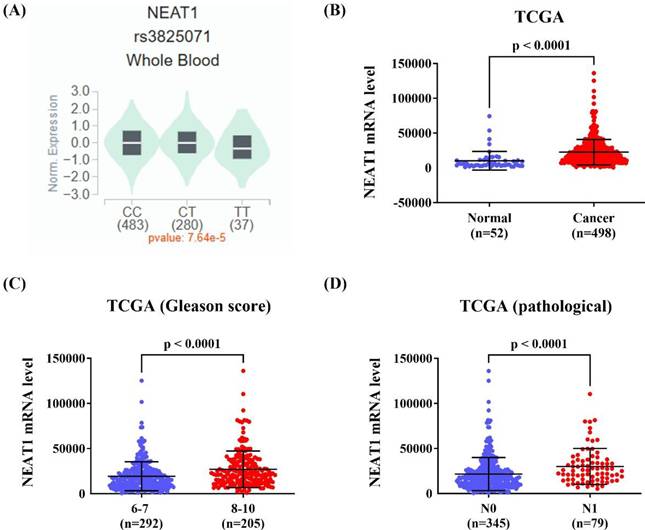
Following the identification of an association between NEAT1 rs3825071 and perineural invasion in prostate cancer, we further explored the potential functional relevance of NEAT1 using publicly available transcriptomic data from the Genotype-Tissue Expression (GTEx) and The Cancer Genome Atlas (TCGA) databases. In the GTEx database, NEAT1 expression in whole blood varied significantly across rs3825071 genotypes (p = 7.64 × 10⁻⁵) (Figure 1A). Analysis of prostate cancer data from TCGA showed NEAT1 upregulation in prostate cancer relative to normal tissue (p < 0.001) (Figure 1B), with higher expression associated with higher Gleason scores (p < 0.001) (Figure 1C) and lymph node metastasis (p < 0.001) (Figure 1D). These results reinforce the observed genetic associations and suggest that NEAT1 polymorphisms may drive prostate cancer progression through modulation of gene expression.
Functional impact of NEAT1 rs3825071 in prostate cancer. (A) NEAT1 expression in whole blood stratified by rs3825071 genotype in the GTEx database (p = 7.64 × 10⁻⁵). (B) NEAT1 expression in prostate cancer versus normal tissue from TCGA. (C) Comparison of NEAT1 expression across Gleason score groups in prostate cancer. (D) Comparison of NEAT1 expression based on lymph node metastasis status in prostate cancer.
4. Discussion
In the present study, we demonstrated that elevated PSA levels at diagnosis were significantly associated with adverse clinicopathological features in patients with prostate cancer. Individuals with PSA >10 ng/mL exhibited higher Gleason grade, more advanced tumor stage, increased lymph node involvement, and higher rates of seminal vesicle invasion, perineural invasion, lymphovascular invasion, and biochemical recurrence. With respect to genetic factors, we found that Neat1 rs3825071 was significantly associated with PSA stratification, with CT and CT+TT genotypes showing a reduced likelihood of presenting with PSA >10 ng/mL. This finding suggests a potential protective role of this polymorphism in modulating prostate cancer progression.
NEAT1 expression is frequently dysregulated in prostate cancer [21, 22]. In addition to aberrant NEAT1 expression, NEAT1 polymorphisms have been associated with clinical outcomes in various cancers [23, 24, 28]. Our findings indicate that NEAT1 rs3825071 may influence NEAT1 expression through both regulatory and functional mechanisms. Consistent with our findings in the GTEx database (Figure 1A), Gerile et al. reported that NEAT1 expression in individuals with the CT and TT genotypes was significantly lower than in those with the CC genotype of rs3825071 in the HIV-1 group [29]. These results highlight rs3825071 as a potential expression quantitative trait locus (eQTL).
NEAT1 participates in a wide range of cancer-related biological activities, such as gene transcription control, chromatin organization, and cellular responses to stress in prostate cancer[30, 31]. In our analysis, individuals with the Neat1 rs3825071 CT or TT genotypes showed a significantly reduced likelihood of perineural invasion compared with those carrying the CC genotype. Previous studies have reported expression patterns of NEAT1 in prostate cancer [20, 31-33]. For example, Chakravarty et al., reported that NEAT1 as a prognostic biomarker for aggressive prostate cancers[32]. Moreover, Bai et al. found that NEAT1 was significantly upregulated in prostate cancer tissues and correlated with TNM stage, lymph node and distant metastasis, and Gleason score [33]. In our analysis of human prostate cancer using data from TCGA, NEAT1 expression was elevated in tumor tissues compared with normal counterparts and was further increased in cases with lymph node metastasis. These findings suggest that the NEAT1 rs3825071 polymorphism may contribute to perineural invasion in prostate cancer, potentially through modulation of NEAT1 expression. Collectively, these observations support the notion that genetic variation in NEAT1 can influence its biological function and, in turn, affect tumor aggressiveness, particularly with respect to neural invasion. Nevertheless, further studies are warranted to validate these findings, including analyses with larger sample sizes, longer follow-up durations, and independent cohort validation, especially in Asian populations and publicly available datasets.
In conclusion, our findings indicate that the NEAT1 rs3825071 polymorphism is associated with PSA levels and perineural invasion in patients with prostate cancer. The NEAT1 rs3825071 CT and TT genotypes appear to confer a protective effect, particularly in patients with elevated PSA levels. These results suggest that NEAT1 rs3825071 may serve as a potential genetic biomarker for disease aggressiveness. Further large-scale and functional studies are warranted to elucidate the underlying mechanisms and to validate its clinical utility.
Acknowledgements
This study was supported by Chung Shan Medical University Hospital (CSH-2026-E-003-Y3). This study was also funded by China Medical University, Taichung, Taiwan (CMU105-N-02).
Competing Interests
The authors have declared that no competing interest exists.
References
1. Kratzer TB, Mazzitelli N, Star J, Dahut WL, Jemal A, Siegel RL. Prostate cancer statistics, 2025. CA Cancer J Clin. 2025;75:485-97
2. Baciarello G, Gizzi M, Fizazi K. Advancing therapies in metastatic castration-resistant prostate cancer. Expert Opin Pharmacother. 2018;19:1797-804
3. Lin LW, Lin TH, Swain S, Fang JK, Guo JH, Yang SF. et al. Melatonin Inhibits ET-1 Production to Break Crosstalk Between Prostate Cancer and Bone Cells: Implication for Osteoblastic Bone Metastasis Treatment. J Pineal Res. 2024;76:e70000
4. Ilic D, Djulbegovic M, Jung JH, Hwang EC, Zhou Q, Cleves A. et al. Prostate cancer screening with prostate-specific antigen (PSA) test: a systematic review and meta-analysis. Bmj. 2018;362:k3519
5. Lavallée LT, Binette A, Witiuk K, Cnossen S, Mallick R, Fergusson DA. et al. Reducing the Harm of Prostate Cancer Screening: Repeated Prostate-Specific Antigen Testing. Mayo Clin Proc. 2016;91:17-22
6. Lin CY, Wang SS, Yang CK, Li JR, Chen CS, Hung SC. et al. Genetic polymorphism and carbonic anhydrase 9 expression can predict nodal metastatic prostate cancer risk in patients with prostate-specific antigen levels ≤10 ng/ml at initial biopsy. Urol Oncol. 2019;37:814.e9-e16
7. Lin CY, Wang CL, Wang SS, Yang CK, Li JR, Chen CS. et al. WWOX Polymorphisms as Predictors of the Biochemical Recurrence of Localized Prostate Cancer after Radical Prostatectomy. Int J Med Sci. 2023;20:969-75
8. Chou YE, Hsieh MJ, Wang SS, Lin CY, Chen YY, Ho YC. et al. The impact of receptor of advanced glycation end-products polymorphisms on prostate cancer progression and clinicopathological characteristics. J Cell Mol Med. 2021;25:10761-9
9. Klotz L. Prostate cancer overdiagnosis and overtreatment. Curr Opin Endocrinol Diabetes Obes. 2013;20:204-9
10. Bhan A, Soleimani M, Mandal SS. Long Noncoding RNA and Cancer: A New Paradigm. Cancer Res. 2017;77:3965-81
11. Su SC, Reiter RJ, Hsiao HY, Chung WH, Yang SF. Functional Interaction between Melatonin Signaling and Noncoding RNAs. Trends Endocrinol Metab. 2018;29:435-45
12. Su SC, Yeh CM, Lin CW, Hsieh YH, Chuang CY, Tang CH. et al. A novel melatonin-regulated lncRNA suppresses TPA-induced oral cancer cell motility through replenishing PRUNE2 expression. J Pineal Res. 2021;71:e12760
13. Carbone FP, Hanau S, Bianchi N. Circular and Long Non-Coding RNAs in Cancer Metabolism: Dual Perspective of Biomarkers and Therapeutic Targets. Noncoding RNA. 2026 12
14. Hussain MS, Gupta G, Afzal M, Alqahtani SM, Samuel VP, Hassan Almalki W. et al. Exploring the role of lncrna neat1 knockdown in regulating apoptosis across multiple cancer types: A review. Pathol Res Pract. 2023;252:154908
15. Long F, Li X, Pan J, Ye H, Di C, Huang Y. et al. The role of lncRNA NEAT1 in human cancer chemoresistance. Cancer Cell Int. 2024;24:236
16. Zhang Y, Wen Y. The Role of LncRNA NEAT1 in Gastric Cancer: Tumor Development and Potential Therapeutic Target. Curr Pharm Des. 2023;29:2213-22
17. Hussain MS, Afzal O, Gupta G, Goyal A, Almalki WH, Kazmi I. et al. Unraveling NEAT1's complex role in lung cancer biology: a comprehensive review. Excli j. 2024;23:34-52
18. Farzaneh M, Abouali Gale Dari M, Anbiyaiee A, Najafi S, Dayer D, Mousavi Salehi A. et al. Emerging roles of the long non-coding RNA NEAT1 in gynecologic cancers. J Cell Commun Signal. 2023;17:531-47
19. An C, Wang I, Li X, Xia R, Deng F. Long non-coding RNA in prostate cancer. Am J Clin Exp Urol. 2022;10:170-9
20. Li X, Li Y, Zhang L, Long H. Single-cell sequencing analysis revealed that NEAT1 was a potential biomarker and therapeutic target of prostate cancer. BMC Cancer. 2024;24:1242
21. Wen S, Wei Y, Zen C, Xiong W, Niu Y, Zhao Y. Long non-coding RNA NEAT1 promotes bone metastasis of prostate cancer through N6-methyladenosine. Mol Cancer. 2020;19:171
22. Xu W, Wu Y, Zhang G. NEAT1 promotes the progression of prostate cancer by targeting the miR-582-5p/EZH2 regulatory axis. Cytotechnology. 2024;76:231-46
23. Chen KJ, Chuang CY, Lien MY, Su CW, Chen MY, Tsai HC. et al. Genetic associations of Neat1 polymorphisms with clinicopathologic characteristics of tongue cancer. Int J Med Sci. 2025;22:1208-14
24. Shiu BH, Hsieh YH, Huang CC, Tang CH, Chang LC, Su SC. et al. Genetic association of NEAT1 gene polymorphism with the progression of colorectal cancer. J Cancer. 2025;16:4338-45
25. Ji X, Yan Y, Ma N, He G, Wang K, Zhang Y. et al. Variant of SNPs at lncRNA NEAT1 contributes to gastric cancer susceptibility in Chinese Han population. Int J Clin Oncol. 2021;26:694-700
26. Lin CY, Wang SS, Yang CK, Li JR, Chen CS, Hung SC. et al. Impact of GAS5 genetic polymorphism on prostate cancer susceptibility and clinicopathologic characteristics. Int J Med Sci. 2019;16:1424-9
27. Weng WC, Hsieh YH, Lin CY, Liu YF, Su SC, Wang SS. et al. Functional variants of the pentraxin 3 gene are associated with the metastasis and progression of prostate cancer. J Cell Mol Med. 2024;28:e70041
28. Hu Z, Chen J, Meng P, Li M. Association between NEAT1 polymorphism and the risk of lung cancer: A protocol for systematic review and meta-analysis. Medicine (Baltimore). 2021;100:e25478
29. Gerile S, Wo X, Li S, Xu X, Zhang D, Kang Z. LncRNA NEAT1 rs3825071 polymorphisms associated with HIV-1 infection in the Hulunbuir population of China. Infect Dis Now. 2026;56:105184
30. Zhao W, Zhu X, Jin Q, Lin B, Ji R. The lncRNA NEAT1/miRNA-766-5p/E2F3 Regulatory Axis Promotes Prostate Cancer Progression. J Oncol. 2022;2022:1866972
31. Nitusca D, Marcu A, Dema A, Balacescu L, Balacescu O, Bardan R. et al. Long Noncoding RNA NEAT1 as a Potential Candidate Biomarker for Prostate Cancer. Life (Basel). 2021 11
32. Chakravarty D, Sboner A, Nair SS, Giannopoulou E, Li R, Hennig S. et al. The oestrogen receptor alpha-regulated lncRNA NEAT1 is a critical modulator of prostate cancer. Nat Commun. 2014;5:5383
33. Bai J, Huang G. Role of long non-coding RNA NEAT1 in the prognosis of prostate cancer patients. Medicine (Baltimore). 2020;99:e20204
Author contact
Corresponding author: Shun-Fa Yang, PhD. Or Chih-Hsin Tang, PhD. Institute of Medicine, Chung Shan Medical University, 110, Section 1, Chien-Kuo N. Road, Taichung, Taiwan, ROC. Fax: 886-4-24723229. E-mail: ysfedu.tw (Shun-Fa Yang); E-mail: chtangcmu.edu.tw (Chih-Hsin Tang)